
Empire! 10: After the End.
On the continent of Marera, four great nations vied for supremacy, each unable to gain an edge over the others, each possessing weapons capable of utterly annihilating each other. Their decades-long cold war boiled over, first into proxy conflict between the smaller nations surrounding them, then, after they had absorbed their lesser neighbors, it grew hot. Every weapon in their considerable arsenals was unleashed.
Radioactive hellfire scoured the continent clean.
But this was not the end of the world, merely the end of the Old World, for there were contingency plans in place. Massive underground structures had been constructed, Vaults capable of withstanding a nuclear blast, and supplied to sustain thousands of people over centuries of waiting. And when the shadow of nuclear war loomed large on the horizon, your ancestors were invited, herded, or possibly even forced into a Vault to weather the coming storm.
The waiting was hard. Machines your people relied on failed, caches of ancient, advanced technology broke down or were stripped for parts to repair vital infrastructure. Radiation caused mutations in your people. Limited resources necessitated desperate solutions to ensure survival. And societies changed in response to the destruction wrought by the war, the long confinement, and the harsh conditions.
Now, it has been 200 years. The projections your ancestors were given told them the surface world would be suitable for recolonization at this time. Ancient elevators are reopened. People who have only heard of the sun, moon and stars in stories now see them with their own eyes. It is time for you to make your way in the New World and maybe, just maybe, regain the glory of the Old.
But beware. The conflicts of old do not die easily. They may ensnare you and usher in a new age of apocalypse... and unlike your ancestors, you have no contingency plans available to you...
Welcome to Empire!
Empire! is a community world-building game where players take on the role of leaders of fledgling nations and attempt to grow in power and prestige while navigating a complex international landscape, whether through combat, diplomacy, spycraft, or other means. In this installment, you control a group of survivors emerging from a shielded Vault 200 years after your former nation was decimated by nuclear war. You must learn to navigate the changed world left behind and build a new nation, maybe even an Empire, in the ruins of your once-grand forebears.
Setting Information
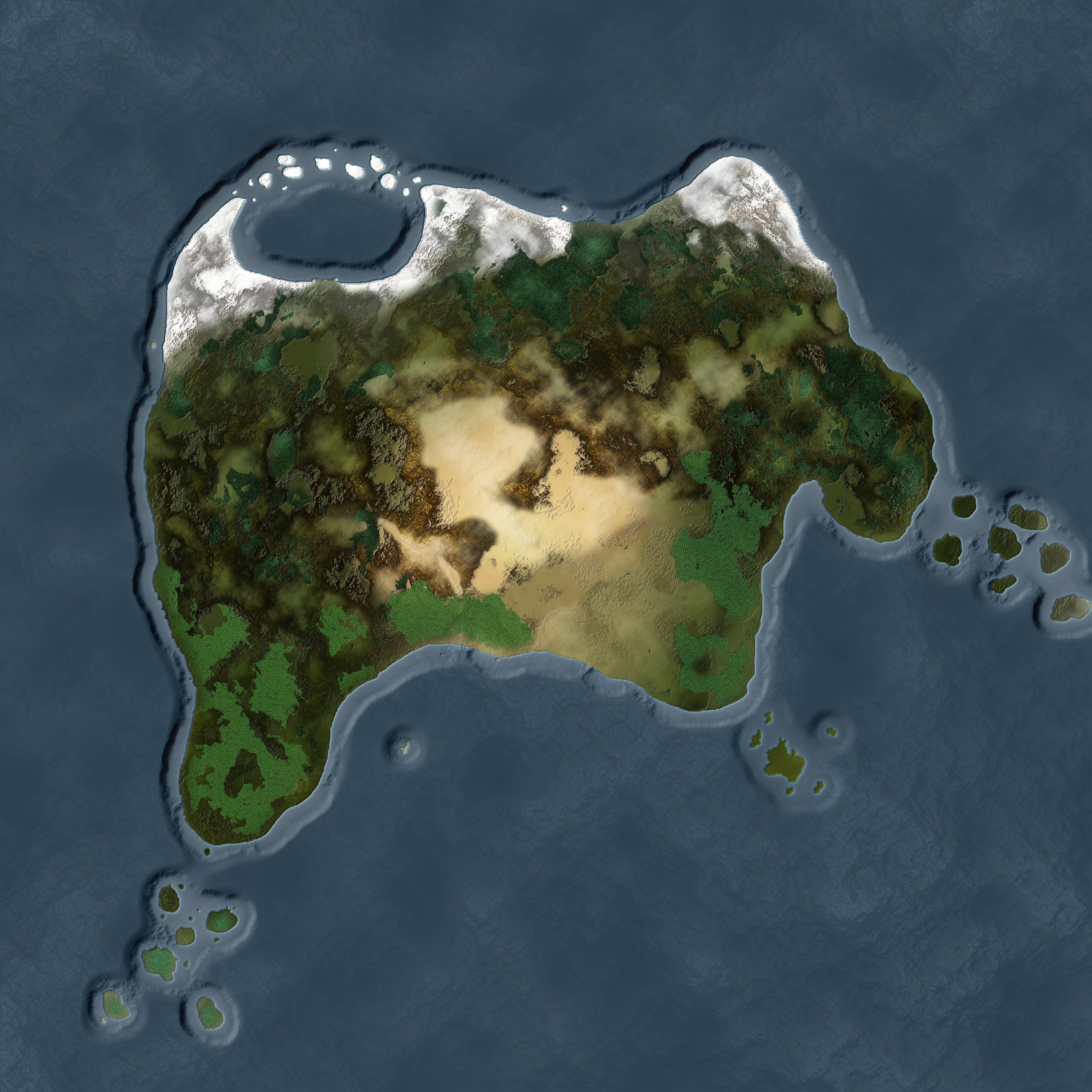
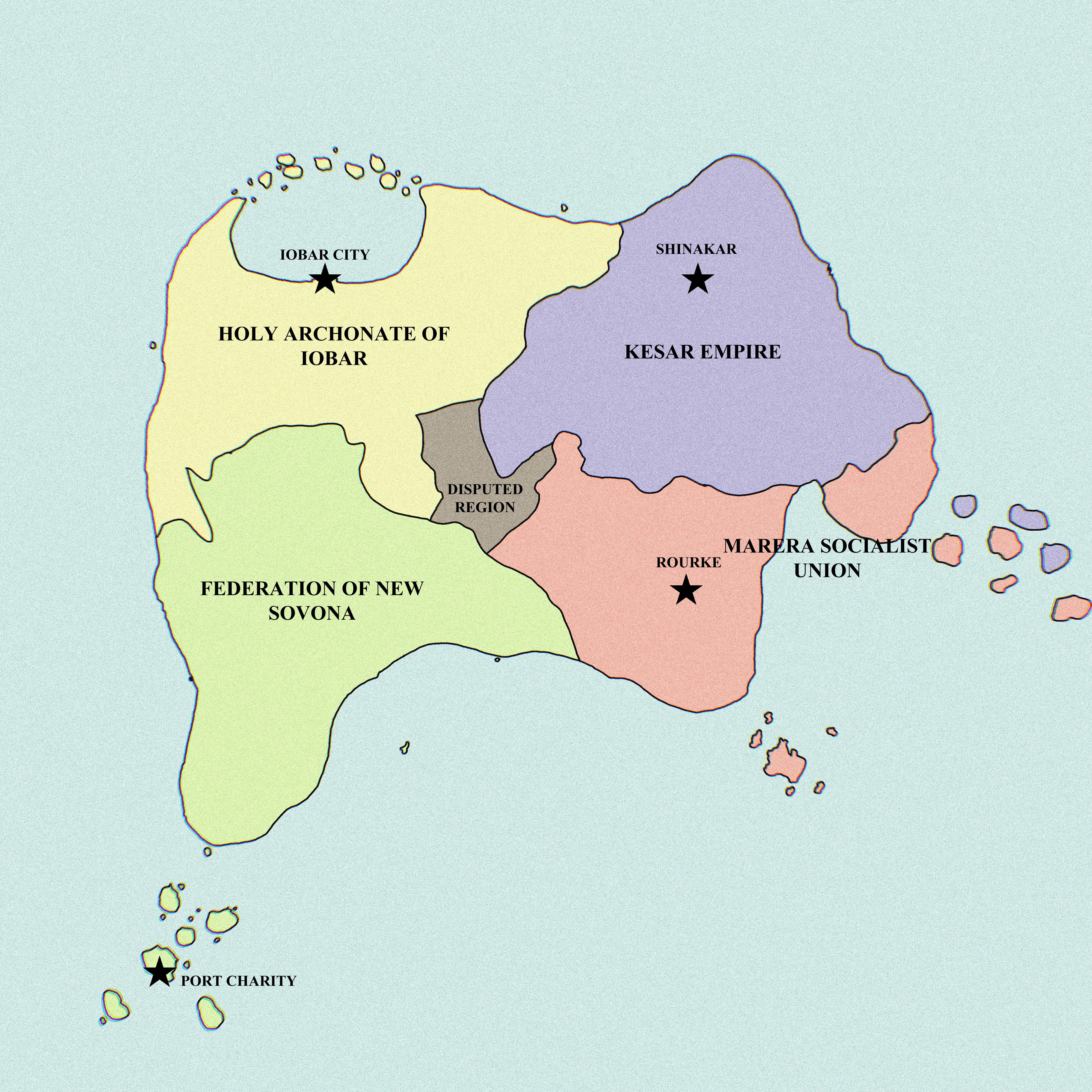
The Continent of Marera
Terrain Map
Prewar Political Map
The Kesar Empire
The oldest nation of Marera was the Kesar Empire, located in the northwest of the continent. In this land of rugged mountains and deep forests, the early Kesarites were a hill tribe, skilled in surviving in harsh conditions. They worshipped the spirits of the mountains, the trees, the animals, and the rivers, and were hardly of notice to any of the fledgling kingdoms of that time, save for the occasional raids on other tribes of the region. All that changed with the advent of Shinakar the Great, a warlord beyond comparison. Under his rule, the Kesarites stormed from their mountain holds into the forests to the west and the plains to the south, subjugating first the other “barbarian” tribes and then the “civilized” peoples beyond them. The plunder and tribute from this conquest was carried back into the mountains, where Shinakar built his great walled city and named it after himself. Eventually, he died, killed in battle during one of his conquests, but his sons continued his legacy, and the Empire of Kesar spread further.
The years of glorious conquest and battle eventually faded, but their memory lived on in the streets of Shinakar, in the many monuments and museums displaying the history of the grand nation. The tribute continued to flow from Kesar’s subjugated peoples, now more or less integrated with the nation as a whole, and with the addition of territories in the central desert, this grew to include a wealth of oil, transforming Kesar into an industrial superpower. Independence movements were met with brutal firepower, as Kesar did not tolerate rebellion, and the successful revolt of the MSU still stung the Kesarite government until the end. But the modern emperors of Kesar and their counseling generals still dreamed of ruling all, a dream stymied by the existence of peer nations, younger though they are, equally well-armed with nuclear firepower.
Kesar was the most multicultural of the Four Nations, as conquered peoples were allowed to keep their practices alive so long as the Empire received its tribute. Dynastic feudalism was the rule of the land, following the example of the Empire itself. Many subject peoples adopted a warrior culture in reflection of their overlords. With such a focus on warfare, Kesar stocked their vaults with a surplus of armaments: start with an additional Unit.
The Holy Archonate of Iobar
While Kesar was already conquering in the northwest, a new religious movement was growing in the fishing villages of the northeast. Nestled in the valley surrounding Shield Bay, protected from the harsh northern climate by mountains on all sides, a new god rose to prominence. Iob was said to be the source of all water and therefore all life, breathing life-giving fluid out through rivers and rainstorms. Iob’s commands were straightforward: Shun the pleasures of the physical world, be content with what you have, and help other believers in their time of need. These and other messages through Iob’s prophets were passed down from generation to generation, and as Iobite sailors expanded their trade networks and Iobite explorers crossed the mountain passes, Iobism spread until it was the most prominent faith on the continent, prevalent especially in ports and along rivers.
But in the face of threats from others less happy with the spreading faith, the Iobite homelands needed to organize. The priests of Iob convened a council and appointed a local nobleman, who they saw as especially virtuous, to the position of Holy Archon, temporal ruler of the Iobite people, responsible for organizing the bureaucracy and the military, for protecting the priests, and for engaging diplomatically with other nations. The council of priests continued to manage spiritual matters, including the massive wealth generated by trade and increasing amounts of tithes. This wealth enabled the Archonate and the Priesthood to build a holy city along the mouth of the river Alph, which they had long held as the most sacred of rivers, which they named Iobar (literally, “city of Iob”).
The trade network and revolutions in banking brought great wealth to Iobar, as it was the largest safe port in northern waters and the gateway to the rich mineral resources of the northeastern mountains and to the waters of the northern seas, bountiful with fish, whales, and eventually, crude oil. The Holy Archon and the Council of High Priests moved into ever grander palaces, and rumors began to spread that they were not the righteous leaders of old, but very corruptible, fallible men who were benefiting from all the pleasures of the world while warning their subjects away from the same vices. Meanwhile, whether or not they were corrupt, these rulers, both temporal and spiritual, saw the other nations for the threats they were. Kesar, where Iobism was completely outlawed, always hungered for more territory, and New Sovona was always one vote away from declaring war on its neighbors. And so, the Holy Archon began to stockpile a nuclear arsenal to deter their neighbors from trying anything.
In Iobar, faith is the primary concern. The Iobitic religion is the defining trait of all who live there, whether they are wholehearted believers or have turned away. Smaller-scale government is usually by a council of priests and an elected Archon. Iobar has a very strong seafaring and mercantile tradition, and stockpiled a portion of their wealth in their vaults: start with 3 Treasure.
The Federation of New Sovona
When Kesar was already a powerful empire and the city of Iobar was partway under construction, tall ships appeared from the southeast, bearing with them exiles from a far-off land with fiery hair unlike anything seen on Marera. These strangers built their new capital of Port Charity on an island in the southeastern sea and spread northward, filling swamps and clearing thick jungles away to create farmland and infrastructure. They displaced or absorbed the smaller nations living there, with those forced to leave migrating to Kesar or Iobar. They brought with them new ideas about governance for which they had been cast out of their former homes, that government should be by the people and for the people. The members of each community voted on a mayor, then each mayor voted on a provincial representative, then each representative of the five provinces voted on a dictator, who ruled the nation for life but required another vote of all the people for certain decisions such as declaring war or changing the constitution. Already more technologically advanced than their neighbors, Sovona’s government focused on maintaining this edge, using the mineral wealth from their northern mountains to fuel it. Port Charity became a shining beacon of research and development. But repeatedly, tensions between the elected dictator and the people at large tore at New Sovona’s unity, while at the same time fear of their neighbors, especially the Marera Socialist Union, caused xenophobia to rise. Increasingly the nation became a powder keg, and its nuclear arsenal the part of the explosive mixture most likely to spill over into its neighbors.
Democracy in some form is the defining feature of New Sovona. Whether they accept the Sovonan system, try to change it, or reject it entirely, all of New Sovona’s successors are marked by its influence. Sovonans have a legacy of being pioneers, first as explorers and settlers during their exile, then in the scientific fields as they struggled for dominance over their neighbors. They preserved as much of this technology as they could for their successors: start with an additional Remnant Technology.
The Marera Socialist Union
A Sovonan philosopher named Rourke would light the fires of change in both his own homeland and in neighboring Kesar. His works espousing worker ownership of industry and claiming the inevitability of class warfare sparked a revolution in both nations, as under the leadership of powerful intellectuals in the newly formed People’s Party, farmers and factory workers rose up and broke away from both nations in a bloody war, establishing the Marera Socialist Union as a separate nation-state. The Sovonan provincial capital was renamed Rourke after their guiding philosopher and became the capital of the new nation, built in the middle of the vast plains that would serve as the fledgling nation’s breadbasket.
While the MSU was founded on the principles of communal ownership of resources, that concept did not last, as under the leadership of fallible men the People’s Party leadership quickly organized into a new oligarchy, and conditions for the working class decayed rapidly. Food was always available, due to the MSU’s ownership of the great southeastern plains, but consumer goods were regularly in short supply, and much was rationed for the military necessary to defend the nation, should New Sovona or Kesar decide to reclaim their former territory. To keep their grip on the nation, the Party increasingly turned to dark measures: assassinations, prison camps, and erasing political enemies from the records became commonplace. This grew into an espionage corps better than any of the other nation, a corps which stole the secrets of nuclear weaponry from New Sovona (or maybe it was Kesar) and gave the MSU the ability to protect itself from reconquest by its neighbors.
The MSU was deeply marked by socialist thought, and witnessed its failings firsthand. Whether its successors reject such beliefs or attempt to succeed at building an equitable state where their predecessors failed, they must live with that legacy. Although they suffered from lack of resources, the people of the MSU had a strong sense of unity and community that kept their resolve strong. Whether or not their successors keep to their socialist roots, these strong bonds will serve them well. The nation’s wealth of food allowed their vaults to house many more people: start with an additional Population in your region.
Themes and Tone
Empire! After the End is a game of post-apocalyptic ruin, war, and devastation, along with mystery, the rebuilding of civilization, and a light dusting of cosmic horror. The ruins of Marera are a harsh place, but there is still room for hope. Here are some thematic guidelines to light your way.
- Much has been lost: the Four Great Nations were far more powerful than you who survived in the vaults, let alone those who did so on the surface. Their knowledge was destroyed by their war, and now it is your responsibility to recover it, or abandon it and find your own path.
- Nature has reclaimed the ruins: Without large human civilizations to maintain their structures, the natural world has moved back in. Cities are overgrown with plant life, glaciers have reclaimed their former reach, and the desert sands have swallowed up settlements and oil derricks alike.
- Humans are corruptible: The Four Great Nations were each corrupt in their own way, and this led to their war. But no one is immune to the lure of power and wealth.
- Fossil fuels are king: The knowledge to harness most renewable sources of power was lost along with the Four Great Nations. In the wasteland, it is those who control the supplies of oil and coal, and therefore fuel for vehicles and generators, that will reign economically supreme.
- Psi is powerful and mysterious: Psi is a newly-discovered phenomenon, and you have yet to understand its cause or its full implications. However, it is a potential avenue for any nation to gain power... or maybe a threat that is not yet fully recognized.
- Advanced Technology is limited: Without the knowledge and massive industrial bases of the Four Great Nations, you cannot replace prewar equipment, and must rely on more primitive means to the same ends.
- Knowledge waits in the ruins: The surviving remnants left behind by the Four Great Nations hold the keys to their technology and therefore their power, and archaeological sites can reveal what happened both immediately before and in the 200 years after the war.
The Apocalypse and You
Two hundred and one years ago, things were at a boiling point. The Four Nations seemed poised to declare war, and to wage it with every weapon at their disposal. Already, small, plausibly deniable skirmishes were occurring at the borders, each side testing the others' defenses and their resolve.
Then, your ancestors got the call. Whether invited or forced, the message was the same across all nations to all the citizens designated for shelter in the Vaults. Evacuate now, or die. Less than 24 hours later, the world above was ablaze, and that was the last you heard of your former nation.
The vaults were designed to last 200 years, long enough for the fallout to settle and for nature to reclaim the wreckage of civilization, or so the scientists and engineers responsible told your ancestors. The truth, however, was that the nuclear bombardment was only the beginning of their ordeal. The Vaults were built, but never tested. Indeed, it would have been impossible to test whether they could survive under their intended conditions, especially not for 200 years. No two vaults suffered the exact same conditions, but many threats were commonplace. The environment quickly took its toll: heat, cold, dust, damp, and even radiation found their way into the vaults, reducing living conditions, damaging delicate machinery and destroying irreplaceable resources. Thousands of people living in cramped quarters brought their own dangers: accumulated filth became a breeding ground for vermin and disease, while being trapped underground in close proximity to others sparked conflict which often turned violent. As supplies grew short, as machines failed, as specialists died before being able to train their replacements, your ancestors lost more and more of the powerful knowledge once held by the Four Great Nations, decaying into a shadow of their former glory.
This is the furnace in which your people were forged. These experiences refined and shaped your ancestors and formed the new foundation of how you would grow into the New World.
Now, it has been one year since you set foot under the sky for the first time in ten generations. The ruins of your former nation have been entangled by the wilderness once more. Those who survived on the surface have suffered even worse than you, surviving as relatively primitive tribes and kingdoms scattered across the surface world. It is time for you to discover what lies in store for you on the surface
Science and Technology
The technology of the Four Great Nations sat slightly more advanced than our technology in the current day of real life. Travel to orbit was possible, if expensive, experiments in energy weapons and magnetic propulsion were beginning to bear fruit, and they possessed an internet much like our own, even if their memes were different.
However, the ordeal of the Vaults has cost you the knowledge and industrial capability necessary to replicate these feats. You still know they are possible, but will need to gradually redevelop those capabilities. You retain caches of prewar supplies, but they are a very finite resource, and as such will need to learn to rely on much simpler technologies. In this state, your technological base resembles the turn of the 20th century, communicating via telegraph and telephone, traveling by horse, steamship, or simple automobile if fuel is available, and using firearms manufactured by experts using precision tools. In terms of combat, your more elite units may still be using prewar equipment, but the vast bulk of your armies will not have such advantages.
The people on the surface are in an even worse place. You lost over 100 years of progress. While their technology is inconsistent, in the best cases, they lost roughly 150 more years than that, putting them roughly on par with the middle of the 18th century. They use flintlock firearms, ride horses for transportation, and communicate exclusively through letters. Many of them recall the war which forced your ancestors underground as "The Hellfire War" or "The Demon War" and advanced technology is frequently viewed with suspicion and occasionally decried as evil magic. Their numbers, however, are much greater than yours, giving them rough parity in their combat forces with yours... for now.
While technology at the start of the game is based on a specific historical period, do not feel constrained by the march of our history when developing your own technologies over the course of this game. Perhaps you want to develop airships into flying battleships, or ignore road infrastructure in favor of canals or rails. The arc of progress in the New World is yours to define.
Psi
The world your ancestors left behind, the world that burned in nuclear fire, was one where the laws of physics reigned supreme. In the world you emerged into, this is no longer the case.
Soon after the Emergence, a small number of members of scouting parties began to experience inexplicable phenomena which defied rational explanation. Many went insane or died shortly afterwards, but soon researchers were able to confirm that while beyond the understanding of science, these events were real. Studies of the few survivors confirmed that their thoughts had a tangible impact on their surroundings, albeit an uncontrolled one. This phenomenon was dubbed "Psi" after a previously discredited theory with a similar meaning.
Roughly 2% of all people are gifted with Psionic powers which awaken at some point in their lives. Despite advances in understanding Psi in the year since the Emergence, an Awakening is still a traumatic and risky experience, and approximately 60% of all Awakenings result in the nascent Psychic dying or slipping into a permanent coma. A much smaller percentage cause uncontrolled physical effects which pose a danger also to the people around them. Should a Psychic survive, their mind is forever changed by the experience, and most Psychics come across as off-putting to ordinary people, with unusual habits and ways of speaking.
Not all Psychics are equally gifted. A vast variety of talents, from heating matter to reading minds, have been observed on a similarly wide range of power scales. Simple experiments have suggested that it is possible for Psychics to learn talents manifested by others, but that doing so requires a great amount of training and discipline.
Philosophers, theologians, and scientists all have a keen interest in the emergence of these new powers and wish to gain further understanding of them.
Mutation
A large minority of surface survivors and a smaller but still quite significant percentage of Vault survivors are Mutants. These not-entirely-human phenotypes were brought about by the intense radiation from the apocalyptic war. A vast variety of mutants appeared shortly after the war, but fewer managed to breed true and create a new lineage of humanity. Mutants tend to have physiological alterations which improve their survival in the post-war world, such as faster healing, hardier digestion able to consume raw meat or poisonous plants, increased physical strength, and other changes. Mutants are, however, usually of equal intelligence to unaltered humans. A few of the most common mutant phenotypes are listed below, but you are free to create your own, subject to GM approval.
Regenerators: The regenerator phenotype is capable of recovering from wounds that would often be lethal to ordinary humans. Their blood clots faster, damaged flesh and muscle knits together more quickly, and they have somewhat stronger resistance to radiation and poison than an ordinary human. However, this strength comes at a cost: Regenerator mutants are often riddled with cancerous tumors, unsightly growths, and parasites, all of which are advantaged by the regenerator's quick recovery from harm.
Eaters: Gaunt and hunched, the Eater phenotype has adapted to become a more effective predator, with fingernails improved into claws, a stronger sense of smell, and a stomach capable of digesting raw meat. These mutants are often reviled by surface settlements due to suspicions of cannibalism that stretch back centuries, but also recognized as the most capable hunters.
Swimmers: Along coasts and rivers, a more graceful mutant phenotype took shape. Swimmers have webbed fingers and toes and slick, hairless skin. Their lung capacity is higher, allowing them to dive underwater for longer while searching for usable food in the depths. These mutants often crew the sailing ships of survivors, and are known as adept fishermen.
If you wish to create your own mutant phenotype, keep the following in mind:
- Mutations grant physical abilities only. Blatantly supernatural powers are the domain of Psi, and not possible through mutation.
- Mutants should still be recognizably human. Humans aren't going to mutate into talking rats or insectoid creatures, but could become slightly more like rats or insects, for example.
Timeline
~1000 BW: Kesar Empire founded
~950 BW: Iobite religion founded
~800 BW: Holy Archonate of Iobar founded
~300 BW: Arrival of Sovonans in Marera, Federation of New Sovona founded
~150 BW: Rourke writes on the merits of communal ownership and workers' revolution
102 BW: Workers in Kesar and New Sovona rebel and form the Marera Socialist Union
~100 BW: Theory of Psi developed by futurists in all nations. Promising scientific experiments performed.
89 BW: Atom bomb developed in New Sovona, used to halt MSU advance into Sovonan territory.
87 BW: Atom bomb concurrently developed in Kesar
86 BW: Atom bomb designs acquired by MSU agents. Their source remains unknown.
85 BW: Atom bomb belatedly developed in Iobar. Period of cold war begins.
67 BW: Long-range ballistic missiles developed by New Sovona and Kesar and quickly copied by MSU and Iobar. All states now possess the ability to annihilate each other's capitals at will.
64 BW: Experiments which previously demonstrated Psi shown to be a sham. Psi considered disproved by mainstream scientific community.
20 BW: The first experiments with Vault construction are undertaken in most nations.
10 BW: Vault construction is massively accelerated due to growing fears of nuclear war.
5 BW: Dozens of Vaults have been completed. Nuclear war seems imminent.
Year 0: Global nuclear exchange. Those able to take shelter in the Vaults. All others are left to fend for themselves on the surface.
200 AW: The Emergence. Survivors from the Vaults finally emerge from isolation into the new world. Genuine Psi phenomena are encountered by Vault survivors for the first time.
201 AW: The first turn of the game begins.
Inspirations
I've consumed a lot of post-apocalyptic media over my lifetime, from things originating during the cold war to more modern takes on the concept. The setting and tone of Empire! After the End is not derived from any one source but from a vast myriad, including many that do not share its genre. The following list is not all-inclusive and the inclusion of a work on the list does not mean anything that appears in that work is approved for inclusion in this one. These works are not required reading or viewing. They are presented in no particular order.
Books, Short Stories, and Poetry
- Alas, Babylon, by Pat Frank
- the Foundation series, by Isaac Asimov
- Ozymandias, by Percy Shelley
- Ozymandias, by Horace Smith
- There Will Come Soft Rains, by Ray Bradbury
- Station Eleven, by Emily St. John Mandel
- Mortal Engines series, by Phillip Reeve
- The City of Ember, by Jeanne DuPrau
Films and Television
-
Episodes of The Twilight Zone (1959 series), including but not limited to:
- Time Enough At Last (S1 E8)
- Perchance to Dream (S1 E9)
- Third from the Sun (S1 E14)
- The Purple Testament (S1 E19)
- The Rip Van Winkle Caper (S2 E24)
- Two (S3 E1)
- The Shelter (S3 E3)
- It's a Good Life (S3 E8)
- One More Pallbearer (S3 E17)
- The Thirty Fathom Grave (S4 E2)
- The Old Man in the Cave (S5 E7)
- Terminator series
- 9
- Akira
Video Games
- Stellaris
- Vaporum and its prequel, Vaporum: Lockdown
- Death Stranding
- Half-Life series
- Horizon Zero Dawn
- Sid Meier's Alpha Centauri
- Phoenix Point
Creating a Region
To apply for the game, follow the instructions in the "Creating a Region" section of the rules document (linked below) and post the results in this channel. The GM will make frequent checks on the channel to provide feedback on or approve submissions.
Unlike some other Empire games, you will not have the opportunity to request specific locations on the map to start, beyond choosing which nation to descend from and your desired type of terrain. This is because the number of regions in the game will be determined by the number of players.
Recruitment will run until the end of February, after which point there will be a short break to finish setting up the game, and then the first round will begin. The game will take a minimum of 10 and maximum of 40 people.
Rounds are 2 weeks long and end at midnight every other Sunday morning.
For Returning Players
If you played in previous Empire! games, much has changed and much has stayed the same. I would recommend reading the sections on Succession, Population, and Psi, as those are the most significant changes from recent games, as well as the updated combat mechanics, but it would behoove you to examine closely any stats you intend to use as while many actions have the same names, their mechanics may be different.
External Links:
Discord Channel: https://discord.gg/jJn9tBbjwq
Rules Document: https://docs.google.com/document/d/1XZiiuEicTUlDWZPsPVJL6wg2yGY1VvnJiV9HnXW9afo/edit?usp=sharing
Tables: https://docs.google.com/spreadsheets/d/1HroxLqYc_AesSgj7s_KsUM9W_cGdALkb_lBa-pWYdXg/edit?usp=sharing
Want to see more? Sign up or log in to read the full game, post, and play — you'll land right back here.