
FALLOUT: REMNANTS
In 2073 the United States of America stands as one of the world’s foremost superpowers, rivaled only by the Sino-Soviet Coalition (SSC); a formidable alliance of China, Russia, and several satellite nations. At the heart of the U.S.'s strength lies its mastery of nuclear fusion and fission technologies, ranging from orbital research stations to advanced consumer robotics. But chief among its assets is a vast arsenal of nuclear weapons, a constant specter looming over an already fragile world.
Decades of political corruption, corporate greed, and environmental negligence have pushed civilization to the brink. Climate change, once dismissed as hysteria, has become an undeniable force of destruction. Rising seas consume entire cities, superstorms lay waste to infrastructure, and expanding deserts erase once-thriving ecosystems. Equatorial regions like Africa, the Middle East, Southern Asia, and large swaths of Latin America are devastated by relentless droughts and catastrophic flooding. Coastal metropolises such as Phoenix, Dubai, and Mexico City crumble into ghost towns, their people scattered to the winds as refugees in search of habitable land.
Canada, spared the worst of the devastation, struggles under the weight of mass migration, its government barely able to manage the influx. Europe suffers a similar fate as its southern nations collapse, while Britain, once an island fortress, begins to buckle under the flood of desperate newcomers. The global order fractures. Nations no longer fight for ideology but for sheer survival. Wars ignite over dwindling food, clean water, and the last remnants of fossil fuels.
By now, the United States is firmly under the grip of the Enclave; a shadowy oligarchy with deep ties to the military-industrial complex. Democracy is little more than a façade, as corporate interests dictate policy and military rule overrides civil governance. The very protocols designed to preserve the continuity of government have instead led to the disintegration of command, leaving the nation in the hands of those more interested in self-preservation than salvation.
As tensions with the SSC escalate, the term "Resource Wars" enters common parlance. What begins as proxy conflicts soon spirals into open warfare. The world teeters on the edge, its leaders too entrenched in their own survival to see the abyss before them.
VAULT-TEC
Amid the chaos, one corporation rises to prominence as humanity’s supposed savior—Vault-Tec. Founded in the mid-21st century, Vault-Tec builds its reputation on government contracts and aggressive marketing, promising underground sanctuaries to shield the populace from nuclear annihilation. In 2054, Operation Safehouse is announced—a national initiative to construct a network of state-of-the-art fallout shelters. Yet, behind the veneer of public service, Vault-Tec is plagued by delays, budget overruns, and layers of secrecy that hint at ulterior motives.
By the 2070s, most Vaults are nearing completion, though whispers of undisclosed experiments and classified projects swirl around the corporation. One such initiative is the Eden Project—a joint venture between Vault-Tec and Cryo-Tek, a firm specializing in cryogenic preservation. Unlike standard Vaults, Eden is designed not for mere survival, but for indefinite stasis. Humanity’s best and brightest—or at least, those deemed most valuable—would be preserved, waiting to awaken in a world reborn.
At its inception, recruitment for the cryonics program appears open to all. Generous signing bonuses lure volunteers with the promise of financial security for their families. But as civilization spirals toward collapse, the selection process shifts. What was once a sanctuary for the desperate transforms into an exclusive retreat for the privileged. Wealthy elites, corporate executives, and political power players bypass the lottery, securing private cryo-suites for themselves. Rumors of hidden facilities and blacklists spread, feeding the paranoia of a society already on the verge of implosion.
The term “Cryoneer” enters the public lexicon—a badge of honor for those entrusting themselves to Vault-Tec’s care. But beneath the surface, the program is something else entirely. The frozen are not just survivors; they are assets, carefully cataloged and preserved, their fates sealed by calculations beyond their understanding.
Vault-Tec’s goal is not to save the world as it was, but to control the one that comes next.
PRELUDE TO WAR
In 2072, the United States completes its annexation of Canada, securing access to critical resources under the guise of North American unity. The war effort intensifies, with U.S. forces pushing into China’s mainland by 2074. Battles rage in Shantou and beyond, but the war soon devolves into a brutal stalemate. The United States pours billions of dollars and countless lives into the conflict, but victory remains elusive. Taxation and wartime revenues sustain the war machine, but morale crumbles as casualties mount.
By 2077, the situation is untenable. SSC forces in Alaska are cut off and crushed in the Battle of Anchorage, yet China refuses to yield. The Enclave retreats to remote locations, anticipating the inevitable. The President and key officials take refuge on an oil rig off the Californian coast—the foundation of what will later become the Enclave's stronghold.
The nation is leaderless, running on inertia. Meanwhile, corporate entities such as RobCo and Big MT collude with Vault-Tec, financing Vault construction and securing their own legacies. Some within Vault-Tec even propose triggering a nuclear first strike to ensure their investments bear fruit, though whether such plans ever reached execution remains a mystery.
On the morning of Saturday, October 23, 2077, the world finally unravels. The war reaches its catastrophic conclusion as a global thermonuclear exchange begins. Within two hours, civilization ceases to exist. The blasts reduce cities to ashes, radiation spreads like an unrelenting plague, and governments collapse in an instant. What remains is a scorched wasteland, where the only law is survival.
THE LUCKY FEW
But you were one of the lucky few. You know nothing of the Great War.
You secured a place in the Eden Project, entombed in a sub-surface vault, suspended in cryogenic stasis as the world outside burned. Now, after an eternity in frozen slumber, you awaken. The old world is gone, reduced to ash and bones. What remains is a land waiting to be reclaimed, reshaped—not in the image of what was, but in the vision of what could be.
This is your new beginning.
EDEN PROJECT
Vault-Tec was best known for its nuclear defense shelters, but also developed technologies to support life underground. These included nuclear reactors, advanced medical tools like organ extractors, and virtual reality systems such as the SimTek 5000, which helped residents adjust to surface life.
To expand its operations, Vault-Tec partnered with several major corporations. RobCo Industries provided Pip-Boys, General Atomics produced nuclear reactors, and Radiation King supplied high-grade electronics.
One of Vault-Tec’s more ambitious plans was the Eden Project. This initiative aimed to preserve humanity by cryogenically freezing volunteers in long-term, subterranean biostorage facilities. It was sold as a way for regular people to glimpse the better, brighter promise of tomorrow. This gave hope and stood out from Vault-Tec’s otherwise grim, utilitarian legacy.
By the 2050's, America was beginning to experience significant economic decline. The Resource Wars were ramping up, oil and uranium were in steep decline globally, sending energy costs soaring, and nations were beginning to hoard resources and withdraw international cooperation. Inflation sharply rose, and the US dollar continued to lose purchasing power as goods become scarcer and more expensive.
Amid this uncertainty, in 2052 Cormorant Industries patented the worlds first functional cryostasis system, dubbed the TimeCradle™. It revealed to the world that it had not only managed to suspend rats, rabbits, dogs and cats, but had also put a gorilla named Mabel in stasis in 2045. They were so confident in their invention that they promised to revive Mabel after ten years in stasis, and show it live to the world on television. Unfortunately, this would prove to be a disaster, as Mabel suffered catastrophic brain function loss during revival and went into cardiac arrest shortly after opening her eyes for the first time. As a result of this, Cormorant stocks plummeted and the President of the United States declared the technology "frozen snake oil" and "bad stuff."
Recognizing the need for a multi-faceted human preservation schema, Vault-Tec would secretly buy the rights to Cormorant's technology and begin developing its own cryostasis system alongside its vaults. The United States Armed Forces experimented with cryonic technology also, and between 2055 and 2076 created various Cryogenic Suspension systems, including the cryonic biostorage chambers in the Sierra Army Depot in California.
The public would remain skeptical of the technology and its safety but later, with some clever marketing, Vault-Tec was able to do what Cormorant could not and successfully revived a chimpanzee named Andy on live television. As Andy was shipped across the country and ran the late-night talent show circuit Vault-Tec began human trials, first on asylum patients and federal prison inmates. Human results were mixed, and there was a disastrous "Generation Zero" failure that few outside of Vault-Tec ever heard about, but before long they had resolved their earlier issues and soon Vault-Tec was able to make a bold public offer of a huge signing bonus for the first human volunteer to successfully earn a spot in "the Eden Project".
It didn't take long for people to come forward and apply for their “place in the future” and the term “cryoneers” was coined in reference to those brave souls willing to leave their old life behind and undergo the artificial freezing process in the hopes that they may one day be reborn.
These people were often from the lower and middle/working classes, drawn by the lure of a payday for their families. The nations growing fascination with cryostasis technology was only enhanced as Cryoneers began appearing in commercials, on billboards and of course radio and network television spots. Vault-Tec even began offering CryoSuites at the Tops Hotel and Casino in Las Vegas.
As the state of the world worsened, interest in cryostasis increased. Up until only a few years before the events of the Great War, it was still possible to secure a spot in the Eden Project. Signing bonuses had long since ended and civilians were now excluded and deemed non eligible for entry. Only select government officials and the extremely wealthy and connected could afford to buy their way into a stasis vault.
 WAR NEVER CHANGES
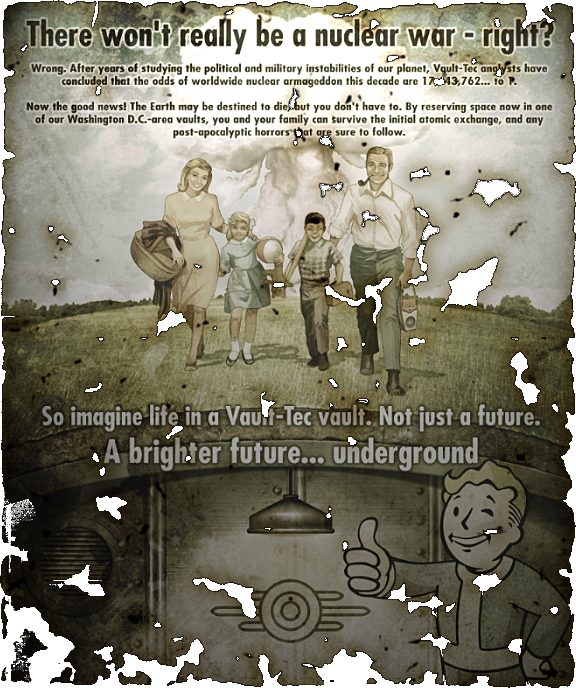
The world of Fallout is a haunting tapestry of hope, horror, and human endurance. Spanning five mainline games, a television series, and an expansive web of online lore, the series chronicles the shattered remnants of the United States and the powers that rose from its ashes after the Great War. From the West Coast to the East, the slow collapse and uneven rebirth of civilization test the boundaries of human nature. While the setting can sometimes veer into the weird and the absurd, I tend to focus on what I believe to be the core thematic intent of the series: a grim, often hopeless world—yet one where humanity refuses to surrender or simply fade away.
The divergence from our timeline began sometime after World War II and solidified by the early 1960s. Rather than advancing along the lines of digital computing and microelectronics, the world of Fallout focused its technological ambitions on atomic energy and robotics. Despite technical progress, human culture remained culturally and socially stagnant, locked in the aesthetics, values, and paranoia of the postwar 1950s. The Cold War never ended. In my version of this timeline, the Soviet Union did not collapse or quietly diminish. Instead, it allied with the People's Republic of China to form a powerful geopolitical rival to the United States, known simply as the Coalition.
By the end of the 1960s, the United States had reorganized into thirteen commonwealths—a new governmental tier between the states and the federal government—marked by a redesigned flag bearing thirteen stars. The 21st century brought the illusion of prosperity. Corporations like General Atomics revolutionized daily life by mass-producing robotic laborers. Directed energy weapons—lasers and plasma—entered military and civilian circulation, standing beside conventional firearms. On the surface, it appeared to be a new golden age.
But all this would soon change.
THE GREAT WAR
The United States Pacific Fleet detected several unidentified submersible contacts off the coast of California. Simultaneously, a squadron of high-altitude bombers was reported near the Bering Strait—believed to be Coalition forces. On the East Coast, the Chinese stealth submarine Yangtze launched a near-full payload of nuclear warheads, its final missile failing to fire due to mechanical error.
Within hours, the Integrated Operational Nuclear Detection System tracked multiple launches. The United States moved to DEFCON 2. With NORAD confirming the inbound strikes, the President authorized full retaliation.
The West Coast was hit first.
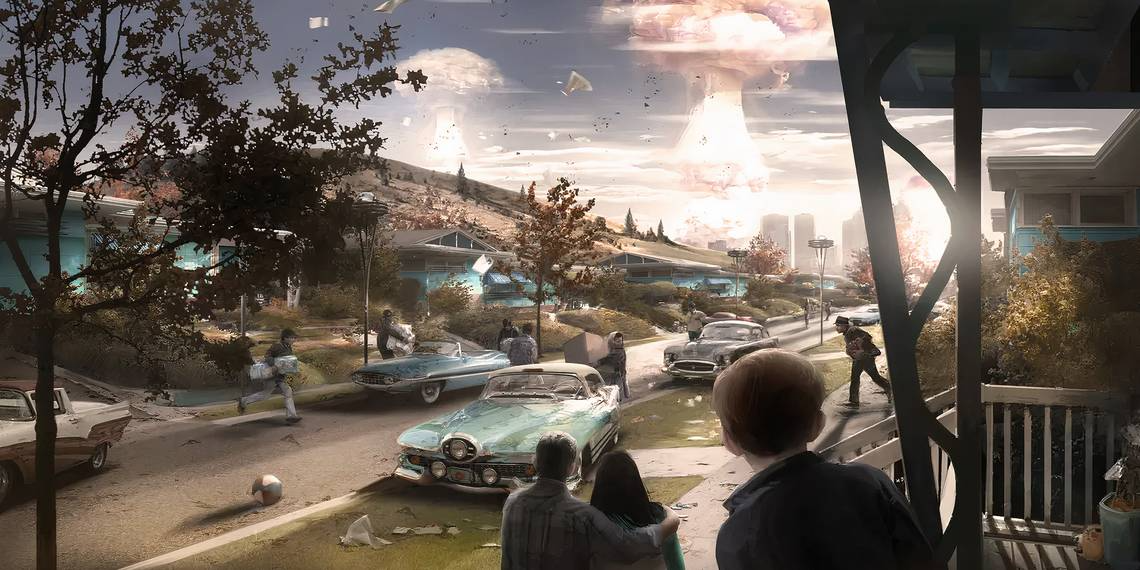
Nuclear warheads rained down across the continent—Pennsylvania, New York, Washington D.C.—obliterating cities, infrastructure, and communications. The exchange lasted roughly two hours. Civilization collapsed in a wave of radioactive fire.
The warheads used during the Great War ranged between 200 and 750 kilotons in yield. Some Coalition munitions exceeded that, but the lower-yield strikes were far more devastating in the long run. Their detonations saturated the lower atmosphere with debris and irradiated matter, triggering a thick, choking fallout that slowly blanketed the planet.
Humanity was nearly erased in a single day.
Now, 222 years later, war is still with us for even that terrible near was not the end—only a reset.
From the ashes of the old world, new ideologies, factions, and dogmas have emerged. Old grudges are reborn in new forms. The faces of soldiers change, but the nature of war does not. War is a force of entropy—an engine that never rests. It churns ceaselessly, fed by blood, sustained by flesh, and empowered by death. It does not think, or feel, or sleep. It simply is.
Because war... war never changes.
CHARACTER SHEETS
So, I've decided to switch from using the previously linked Google Sheets-based character sheets and have switched over to using Fantasy Grounds VTT. Players will not need to purchase anything, and I am hosting the game server for handling the character sheets, though there are options for you to store editable copies of your character sheet on your maching as there is an exportable .xml version.
I have put more information and isntructions on this in the accompanying OOC discord server here: https://discord.gg/ZXuPerxf
Specifically, the instructions for creating your character inside Fantasy Grounds is here: https://discord.com/channels/1370413036426236046/1435771652599185438/1456186236229386354
Want to see more? Sign up or log in to read the full game, post, and play — you'll land right back here.