
Tales of the Weeping Willows
Tengoku Empire (天国帝国)
The Tengoku Empire, once a bastion of unity and prosperity, now finds itself embroiled in turmoil following the passing of its revered emperor. With no clear successor to the throne, the realm has fractured into the hands of five powerful clans, each vying for dominance over the empire. Amidst this chaos, a council of five lords has been established to govern the realm until the emperor's heir comes of age. However, intrigue, betrayal, and conflict plague the empire as the clans vie for control, threatening to tear the realm apart.
Major Clan and political leadership
The governance of the Tengoku Empire rests in the hands of a council of five lords, each representing a major clan until the young heir of the empire is ready to guide the country into the future.
Clan Shirogane: Masters of martial prowess and ancestral reverence, Clan Shirogane controls the western provinces under the leadership of Lord Takeshi Shirogane. They uphold principles of discipline and honor, drawing strength from their warrior traditions and spiritual connections.
Clan Kaguya: Renowned for their mastery of balance and diplomacy, Clan Kaguya governs the southern territories led by Lady Haruka Kaguya. They excel in negotiation and seek to maintain stability amidst the empire's tumultuous landscape.
Clan Kurohitsuji: Keepers of arcane knowledge and ancient secrets, Clan Kurohitsuji presides over the eastern lands with Lady Yuki Kurohitsuji at the helm. They delve into forbidden magic and commune with otherworldly entities to bolster their power.
Clan Akechi: Experts in deception and illusion, Clan Akechi rules the northern provinces under Lord Ren Akechi's guidance. They manipulate perception and reality, employing stealth and subterfuge to outmaneuver their rivals.
Clan Tachibana: Innovators and craftsmen, Clan Tachibana dominates the central regions led by Lady Emi Tachibana. They harness magical energies to enhance their technological marvels and craftsmanship, driving progress within the empire.
Intrigue and Betrayal
In the shadows of the Tengoku Empire, intrigue and betrayal abound as each clan seeks to advance its interests and secure supremacy. Spies lurk in the darkness, assassins strike from the shadows, and alliances shift like the wind as the lords scheme and plot against one another. Minor clans, eager to curry favor with the major powers, become pawns in the deadly game of politics, further escalating tensions within the empire.
Magic
Magic permeates every aspect of life within the Tengoku Empire, with each clan possessing unique mystical abilities:
Clan Shirogane: Known for their dedication to the martial arts and ancestral spirits, Clan Shirogane's magic is deeply intertwined with their warrior traditions. They call upon the spirits of their ancestors for guidance and protection, and their swordsmanship is said to be infused with the strength of those who came before them.
Clan Kaguya: Masters of harmony and balance, Clan Kaguya's magic is focused on the manipulation of energies and the natural world. They have a deep connection to the elements and the spirits of nature, allowing them to commune with animals, manipulate the weather, and shape the land to their will.
Clan Kurohitsuji: Keepers of ancient secrets and arcane knowledge, Clan Kurohitsuji's magic is steeped in mystery and tradition. They delve into forbidden rituals and dark arts, harnessing the power of the shadow realm and communing with spirits both benevolent and malevolent.
Clan Akechi: Masters of deception and illusion, Clan Akechi's magic is centered around stealth and subterfuge. They specialize in the art of illusion, creating phantasms and mirages to confound their enemies, as well as shadow magic to cloak themselves from sight.
Clan Tachibana: Artisans and innovators, Clan Tachibana's magic is expressed through their craftsmanship and ingenuity. They enchant their creations with magical runes and imbue them with elemental energies, creating powerful artifacts and devices that enhance their abilities on the battlefield.
Each clan's unique magical abilities complement their strengths and traditions, allowing them to wield formidable power in their quest for dominance within the Tengoku Empire. But as the realm teeters on the brink of collapse, the fate of the empire hangs in the balance, waiting for a true leader to emerge and unite the warring factions.
Princess Amaya Akatsuki
Princess Amaya Akatsuki: Heir of the Tengoku Empire
Princess Amaya Akatsuki, at the age of 16, stands as the beacon of hope and the future of the Tengoku Empire. Born into the illustrious Akatsuki lineage, she carries the weight of her family's legacy upon her young shoulders. As the only child of the late emperor, she is the designated heir to the throne, destined to lead the empire into a new era.
Background:
Amaya's upbringing has been one of privilege and expectation. From a tender age, she has been groomed for leadership, receiving the finest education and training in matters of statecraft, governance, and combat. Despite her youth, Amaya has shown remarkable maturity and intelligence, displaying a natural talent for leadership and diplomacy.
Character:
Princess Amaya is a precocious and spirited young girl, possessing a keen intellect and a thirst for knowledge. She approaches each new challenge with optimism and resilience, undaunted by the weight of her responsibilities. Fiercely loyal to her family and her people, she is determined to honor her legacy and protect the empire from its enemies.
Physical Description:
Amaya is a vision of grace and pure beauty, with features that evoke the ethereal elegance of a celestial being. Her long, ebony hair cascades down her back in silky waves, framing a face of delicate symmetry and refinement. Almond-shaped eyes radiate with intelligence and warmth, drawing others to her with their captivating allure. Her skin, porcelain-pale and flawless, seems to glow with an inner luminance, enhancing her ethereal beauty.
Titles and Responsibilities:
Her full title, Her Royal Highness Princess Amaya Akatsuki, Heir Apparent to the Tengoku Empire, Defender of the Realm, Keeper of the Imperial Flame, Guardian of the Sacred Ancestral Spirits, reflects her esteemed position within the empire. Despite her young age, she actively participates in the affairs of state, accompanying her advisors to council meetings and engaging in diplomatic negotiations.
Future:
As the future ruler of the Tengoku Empire, Princess Amaya faces daunting challenges and formidable adversaries. Yet, with her unwavering determination, indomitable spirit, and the support of her loyal subjects, she stands poised to lead her people into a new era of prosperity and peace. The fate of the empire rests in her hands, and the world watches with bated breath as she prepares to write the next chapter of its history.
Social Structure
Emperor and Imperial Family: At the pinnacle of society, the emperor and his immediate family hold supreme authority, revered as divine figures embodying the spiritual and political essence of the nation.
Shogun: Second only to the emperor, the shogun serves as the military dictator, wielding considerable power and commanding the loyalty of the samurai class. The shogun effectively governs the country on behalf of the emperor. This position is not occupied at the moment in Tengoku, instead the sacred council of the five lords is ruling on behalf of the imperial heir.
Daimyo (Feudal Lords): Beneath the shogun are the daimyo, feudal lords who rule over vast territories granted to them by the shogunate. They maintain their own armies, administer justice, and collect taxes, effectively governing their domains as semi-autonomous rulers.
Samurai: The warrior class, samurai, serve as the backbone of the military and hold significant social prestige. They are sworn vassals to the daimyo, tasked with upholding the code of bushido (the way of the warrior) and protecting their lord's interests.
Peasants: The majority of the population, peasants, are farmers who work the land owned by the daimyo. They are obligated to pay taxes and perform labor services for their lords in exchange for protection and the right to cultivate the land.
Artisans and Merchants: Beneath the peasants are artisans and merchants, who form the backbone of urban society. Artisans craft goods ranging from pottery to textiles, while merchants engage in trade and commerce, facilitating the exchange of goods and wealth.
Ronin: Samurai who have lost their masters or fallen out of favor may become ronin, masterless warriors who wander the land in search of employment. Though they often face societal stigma, skilled ronin can still find work as mercenaries or bodyguards.
Outcasts (Eta and Hinin): At the bottom of the social hierarchy are the outcasts, including the eta (untouchables) and hinin (non-humans). These marginalized groups perform taboo occupations such as butchery, tanning, and executioner duties, facing severe discrimination and social ostracism.
This hierarchical structure is characterized by its rigid social boundaries, with mobility between classes typically limited and determined by birth or circumstance.
Here are more details about Daimyo and Samurai ranks.
Daimyo: Feudal lords who govern over territories known as domains or han, maintaining their own armies, administering justice, and collecting taxes within their semi-autonomous domains.
Fudai Daimyo: Vassal lords who serve the emperor directly, holding strategic or prestigious domains close to the seat of power. Only the five lords of the council currently have this rank.
Hatamoto: Elite retainers who serve the shogun or daimyo directly, holding positions of trust and authority within their households or administrations.
Fudai Hatamoto: A subset of hatamoto who serve the daimyo loyally for generations, holding hereditary positions within the daimyo's administration.
Gokenin: Vassal samurai who serve a daimyo or shogun indirectly, holding land or positions of authority in exchange for their loyalty and military service. This is a lower position then Hatamoto, as they don't usually serve their lord directly in the day to day. While some gokenin may hold prestigious positions and enjoy significant privileges, others may have lower-ranking roles and fewer benefits.
Karō-ichimonji: Chief retainers of the daimyo, holding the highest-ranking positions within the domain's administration and wielding significant influence over policy-making and decision-making. Most of them are bureaucrat that make the gouverment works
Karō: Senior retainers and advisors to the daimyo, responsible for managing the domain's affairs and overseeing land administration, taxation, and justice.
Koke: Noble courtiers of the imperial court in Kyoto, known for their refined culture, scholarship, and artistic pursuits.
Shugo: Provincial governors appointed by the shogun or daimyo to oversee the administration and defense of specific regions or provinces.
Bushi: The rank-and-file samurai who serve their lords faithfully in various capacities, dedicating their lives to the pursuit of martial excellence and the fulfillment of their duties.
Proxies Armies
Minor clans, eager to curry favor with the major clans, often serve as proxy armies in the conflicts between the lords. These clans, though lacking the resources and influence of their larger counterparts, play a crucial role in the power struggles that grip the Tengoku Empire.
Some minor clans pledge their allegiance to one of the major clans, serving as loyal vassals and providing troops and resources to their chosen lord. Others, however, play a more opportunistic role, shifting their allegiances as it suits their interests or offering their services to the highest bidder.
These proxy armies are deployed in conflicts ranging from covert skirmishes to open warfare, acting as pawns in the ongoing struggle for control of the empire. They fight on behalf of their patrons, carrying out their orders and furthering their agendas, even as they risk their lives on the battlefield.
Amidst the chaos of battle, alliances are forged and broken, and the fortunes of the clans rise and fall. But regardless of their size or stature, each clan plays a vital role in shaping the destiny of the Tengoku Empire, as it teeters on the brink of collapse or the dawn of a new era.
Religions
In the social structure, religion played a significant role, with Bodhisarism (Buddhism) and Jinseism (Shintoism) being the two primary religious traditions. Here's how religion intersected with the social hierarchy:
Bodhisarism (Buddhism)
Monastic Orders: Bodhisari monastic orders, such as the Tendai, Shingon, and Zen schools, held considerable influence within society. Monks and nuns served as spiritual guides, educators, and caregivers, providing religious services and support to the populace. Connections to the Nobility: Bodhisari temples often enjoyed patronage from the nobility, including daimyo and shoguns, who would donate land, funds, and artworks to support the monastic communities. In return, temples offered prayers and rituals for the prosperity and protection of their patrons.
Cultural and Artistic Influence: Bodhisarism exerted a profound influence on the empire's culture, inspiring the development of literature, art, architecture, and ritual practices. Bodhisari temples served as centers of learning and artistic expression, contributing to the enrichment of society.
Jinsei (Shintoism)
Indigenous Beliefs: Jinseism, originally an indigenous religion, revolved around the worship of kami, or divine spirits, associated with natural phenomena, ancestors, and deities. Jinsei shrines served as sacred sites where rituals and ceremonies were performed to honor and appease the kami.
Imperial Patronage: Jinseism was closely tied to the imperial family, with the emperor regarded as a descendant of the sun goddess Amaterasu, the most important kami in the Jinsei pantheon. Jinsei rituals and ceremonies were conducted to legitimize the emperor's divine authority and ensure the prosperity of the nation.
Community Practices: Jinseism permeated all aspects of society, with communities participating in seasonal festivals, rites of passage, and purification rituals to maintain harmony with the natural world and seek protection from malevolent forces.
Syncretism
Coexistence and Synthesis: Bodhisarism and Jinseism coexisted and interacted in a syncretic manner, with practitioners often integrating elements of both traditions into their religious practices. Many Buddhist temples incorporated Jinsei shrines and kami worship, while Jinsei shrines adopted Buddhist rituals and iconography.
Popular Beliefs: Folk beliefs and practices also played a significant role in spirituality, with beliefs in spirits, ghosts, and supernatural forces shaping everyday life. Folk religions, such as Jinsei and the worship of local deities, provided a deeply rooted sense of connection to the land and community.
Summary
Religion permeated every level of society, influencing cultural norms, social customs, and individual beliefs. Bodhisarism and Jinseism provided spiritual guidance, moral values, and a sense of belonging, contributing to the cohesion and stability of the feudal society.
Kawamura 川村
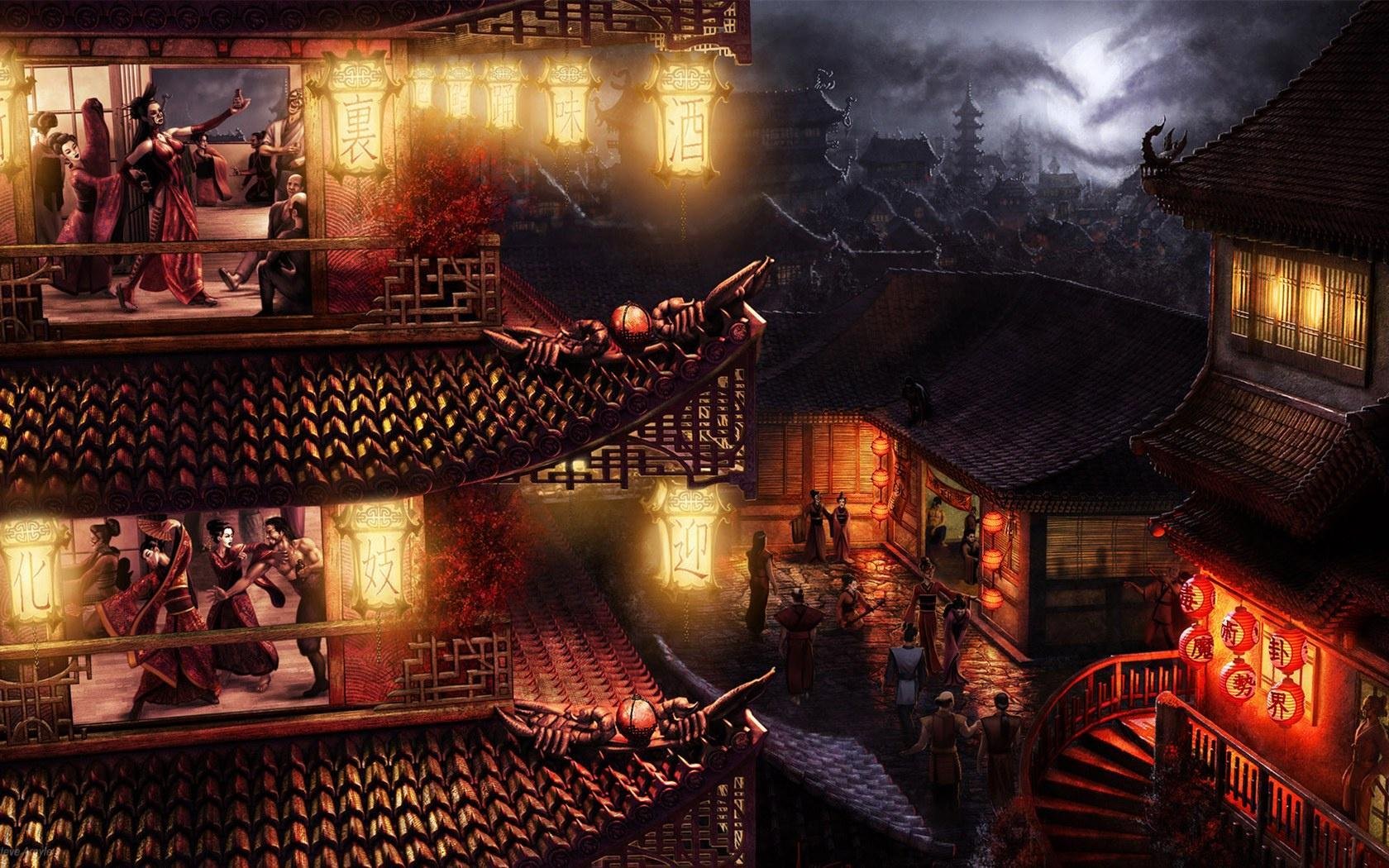
Kawamura (川村), situated at the empire's border within Clan Akechi's domain, stands as a bustling city nestled a few dozens miles from the territories of Clan Shirogane and Kaguya to the south. To the east lies the untamed and perilous Kiri Forest, veiled in a perpetual mist.
As a pivotal trading hub, Kawamura thrives as the only sanctioned city to be allowed to trade with foreigners as Clan Akechi's northern domain is shared with a foreign realm that have an ancient norse culture. Here, amidst the clamor of commerce, anything can be procured for the right price – even exotic slaves from distant lands, destined for roles as miners, laborers or, more tragically, as commodities in the pleasure quarters of the empire.
Control of the city changed hands several times over the history, but always retained its reputation for being a hotbed of criminal activity, having many gambling dens, geisha houses and opium parlors. The city maintained a mask of legitimacy as the empire center for medicinal opium trade. Poppies were grown in vast fields that surround the city, and it's involvement in the opium trade (both legal and illegal) made the city very profitable for its rulers and the empire who collect enormous amount of gold from the infamous plant.
Misaki Akechi, a cunning and mysterious middle-aged woman, holds the esteemed position of mistress over the city. She is not a violent woman, but is known to be merciless with anybody who interfere with the peace of her precious city. Misaki's lineage connecting her to her elder cousin, Lord Ren Akechi, who leads the esteemed Akechi clan. While their familial ties bind them, Misaki exercises autonomous control over the city, and is condierably richer than Lord Ren Akechi. In a mutually beneficial arrangement, the Akechi family affords Misaki considerable freedom in exchange for generous taxation and a steady supply of poppy.
Yet amidst the bustling commerce, sinister whispers pervade the air. Rumors of demons and dark sorcery spread like wildfire through the borderland villages around Kawamura, casting shadows of fear and uncertainty upon the hearts of its inhabitants. In the mist-shrouded forests, tales of vanished souls and unnameable horrors take root, fueling a sense of foreboding that lingers in the air like a haunting melody.
Want to see more? Sign up or log in to read the full game, post, and play — you'll land right back here.